
FAQ -
Frequently Asked Questions
Got questions? You’re in the right place.
If you’re new to Simply MSK, you might be wondering what we actually do, who we help, and where to start.
The short answer?
We help MSK clinicians become more confident, clinically reasoned and joined-up in the way they assess, manage and communicate patient care.
Most clinicians are taught in silos, learning within their own disciplines without acknowledgment of the multidisciplinary team. But real patients do not present in neat little boxes and certainly do not follow the textbooks.
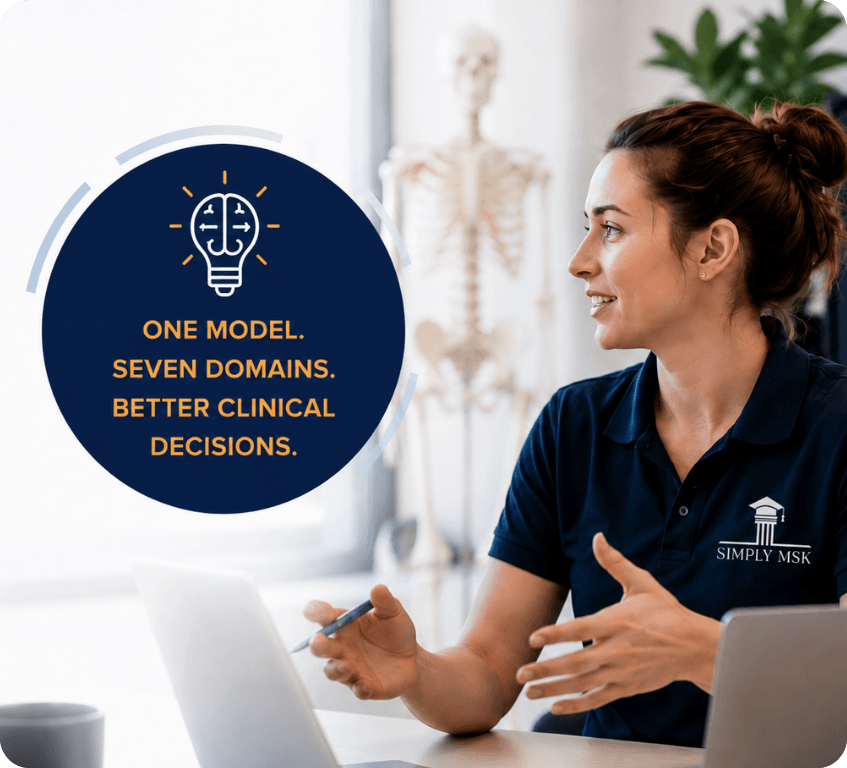
That’s why our core focus is Clinical Reasoning Without Silos; helping clinicians connect the dots between different areas of MSK practice and make better decisions with more confidence.
Our approach is built around the Clinical Reasoning Without Silos Framework, which combines seven reasoning domains with a clear decision-making process, helping clinicians move from clinical problem to clinical action in a more structured way.
Where Should I Start?
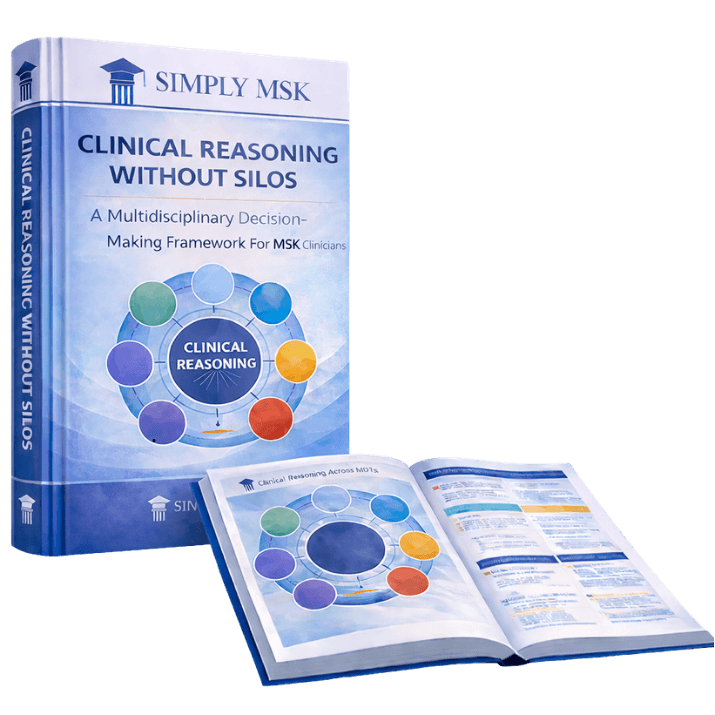
The best place to start is with our free download:
Clinical Reasoning Without Silos: A Multidisciplinary Decision-Making Framework for MSK Clinicians
This gives you a clear introduction to the way we think about MSK decision-making and helps you understand why silo-based reasoning can leave clinicians feeling uncertain.
See What Your Clinical Reasoning Style Is
This helps you reflect on how you currently make clinical decisions and shows you where your reasoning strengths and blind spots may be.
Top Questions
Simply MSK is mainly for:
Student clinicians
Newly qualified clinicians
Less experienced MSK clinicians
Clinicians moving into MSK practice
Clinicians who feel they know “bits” of MSK but struggle to connect everything together
Clinicians who want to feel more confident with assessment, diagnosis, management and decision-making
You may be a physiotherapist, sports therapist, sports rehabilitator, osteopath, chiropractor, doctor, podiatrist, strength and conditioning coach, or another professional working around MSK patients.
We are not here to make everyone think the same.
We are here to help clinicians reason better together.
No.
Although many of our learners are physiotherapists, Simply MSK is built around a multidisciplinary approach.
MSK care is not owned by one profession. Patients often need input from physiotherapy, sports therapy, medicine, radiology, emergency nursing, strength and conditioning, podiatry, orthopaedics, psychology and other areas.
That is why our education is designed to move beyond profession-specific silos and help clinicians understand the bigger clinical picture.
Recommended link: Learn more about why Simply MSK exists
It means not making clinical decisions from one narrow viewpoint.
For example, a knee patient may not simply be a “meniscus case”, a “strength case”, an “MRI case” or a “surgical case”.
Their presentation may involve:
Mechanism of injury
Symptom behaviour
Load tolerance
Strength and capacity
Patient beliefs and expectations
Imaging findings
Risk factors
Sport, work and lifestyle demands
Clinical uncertainty
Referral considerations
Clinical Reasoning Without Silos is about bringing those pieces together so your management plan makes sense.
It helps you move from:
“I know lots of information, but I’m not sure what matters most.”
to:
“I can weigh up the key factors and justify my clinical decision.”
No — in fact, this is exactly the kind of thinking that can help you early in your career.
Many students and junior clinicians feel overwhelmed because they are trying to remember everything:
Special tests
Pathologies
Protocols
Red flags
Rehab exercises
Outcome measures
Anatomy
Research papers
The problem is not that you are not smart enough.
The problem is that MSK is often taught in disconnected sections.
Our aim is to help you organise your thinking so you can approach patients with more structure and less panic.
Recommended link: Start With the Free Framework
Yes.
Even experienced clinicians can fall into reasoning habits.
Sometimes we over-focus on imaging.
Sometimes we over-focus on biomechanics.
Sometimes we over-focus on pain.
Sometimes we over-focus on rehab exercises.
Sometimes we over-focus on diagnosis.
The goal is not to make you start again.
The goal is to sharpen your reasoning, challenge your assumptions, and help you make more joined-up decisions.
If you already have experience, our resources may help you put language and structure around things you are already doing intuitively.
Yes, but we try not to teach them in isolation.
We believe assessment and treatment only make sense when they are linked to clinical reasoning.
So rather than simply saying:
“Do this test.”
“Give this exercise.”
“Follow this protocol.”
We focus on:
Why does this matter?
What does this change?
How does this influence the decision?
What else needs to be considered?
When should we refer on?
When should we progress?
When should we pause?
When should we involve someone else?
That is the Simply MSK difference.
We cover a range of MSK topics, with particular strengths in areas such as:
Knee injuries
Meniscal injuries
ACL rehabilitation and decision-making
Shoulder injuries
Spinal presentations
Lower limb MSK conditions
Clinical reasoning frameworks
Leadership and multidisciplinary practice
Our future course library is being designed to connect condition-specific learning with wider clinical reasoning principles.
Recommended link: Explore our courses
No.
You just need to be curious, reflective and willing to think.
If you have ever thought:
“I’m not sure if I’m missing something.”
“I know the tests, but I’m not sure how to interpret them.”
“I struggle to know what matters most.”
“I feel anxious when patients are complex.”
“I want to be more confident explaining my reasoning.”
“I want to stop relying on protocols alone.”
Then Simply MSK is designed for you.
We are not trying to simply give you more information.
There is already plenty of information out there.
The bigger challenge is knowing how to use it.
Simply MSK focuses on helping clinicians:
Think more clearly
Connect different clinical domains
Avoid narrow silo-based decisions
Understand when different professionals may see things differently
Make decisions they can explain and justify
Feel more confident with uncertainty
Build a more complete picture of the patient
Our aim is to help you develop reasoning architecture, not just collect more clinical facts.
The Clinical Reasoning Quiz is a short reflective quiz that helps you identify your current reasoning style.
It is not designed to judge you.
It is designed to help you notice your patterns.
For example, you may discover that you tend to be:
Very protocol-driven
Very diagnosis-focused
Very imaging-led
Very rehab-focused
Very symptom-led
Very cautious
Very confident but sometimes narrow
Very holistic but sometimes under-structured
Once you know your pattern, it becomes easier to grow.
Recommended link: Take the Quiz
After you download the free framework, you will receive the resource by email.
You may also receive follow-up emails from Simply MSK designed to help you understand and apply the framework in practice.
These emails may include:
Clinical reasoning examples
Case-based reflections
Common mistakes clinicians make
How to avoid silo-based thinking
Invitations to future courses, resources or priority lists
You can unsubscribe at any time.
No.
We hate that too.
We will only send emails that are designed to help you think better, learn better or access relevant Simply MSK resources.
The aim is to add value, not fill your inbox.
Beyond Silos: Multidisciplinary Clinical Reasoning in MSK Practice is our flagship learning experience.
It is designed to help clinicians move beyond isolated knowledge and develop a more complete, multidisciplinary reasoning process.
The course builds on the principles introduced in the free Clinical Reasoning Without Silos framework and takes them deeper through teaching, case examples, decision-making tools and clinical application.
Recommended link: Join the Priority List
This will depend on the specific cohort or version of the course being offered.
Some Simply MSK learning experiences may be live.
Some may be online.
Some may include community discussion.
Some may include self-paced resources.
Some may include certificates or accreditation-style completion.
The best way to stay updated is to join the priority list.
Recommended link: Join the Beyond Silos Priority List
Where a course includes a certificate, this will be clearly stated on the course page.
Our aim is not just to provide a certificate for attendance, but to create learning that genuinely improves your clinical reasoning and confidence.
If a course includes accreditation, completion requirements or assessment elements, these will be explained before you enrol.
Yes — but we also recognise that clinical practice is not just about quoting papers.
Evidence matters.
But so does:
Clinical context
Patient goals
Risk
Experience
Shared decision-making
Communication
Multidisciplinary input
Real-world constraints
Our approach is evidence-informed, clinically practical and designed to help you make better decisions with real patients.
No.
Knee education is a major part of our background and expertise, but Simply MSK is broader than knees.
Our bigger mission is to improve MSK clinical reasoning across conditions, professions and settings.
Knees may be one of our strongest clinical areas, but the Simply MSK model is designed to support reasoning across MSK practice.
Very normal.
MSK can feel overwhelming, especially when you are early in your career.
You are expected to understand anatomy, pathology, assessment, rehab, imaging, red flags, communication, patient expectations, referral pathways and clinical uncertainty.
That is a lot.
Feeling unsure does not mean you are not good enough.
It usually means you need a clearer structure for thinking.
That is exactly what we are trying to help with.
Recommended link: Read: Why Simply MSK Exists
Yes — and this is one of the main reasons Simply MSK exists.
Confidence rarely comes from memorising more tests.
It comes from understanding:
What matters most
What the findings mean
How much weight to give each factor
What options are available
What the risks are
What decision is reasonable
How to explain that decision clearly
That is why we focus so heavily on clinical reasoning, not just clinical content.
Yes.
Our main free resource is:
Clinical Reasoning Without Silos: A Multidisciplinary Decision-Making Framework for MSK Clinicians
We may also share blogs, case reflections, social media posts, videos and other free teaching resources.
Recommended link: Download the Free Framework
Yes.
Our blog is designed to help clinicians think through common MSK challenges in a clear and practical way.
Topics may include:
What silo-based working is
Why clinical reasoning matters
How to assess complex patients
How to think about imaging
How to avoid over-relying on protocols
How to build confidence as a junior clinician
How multidisciplinary reasoning improves patient care
Recommended link: Read the Blog
Potentially, yes.
We are interested in supporting clinicians, students, universities, clinics and organisations who want to improve MSK education and clinical reasoning.
This may include:
Guest teaching
Workshops
Face-to-face courses
Online education
Team training
Clinical reasoning sessions
Collaborative educational projects
Recommended link: Work With Simply MSK
Yes, Simply MSK has delivered face-to-face education and continues to develop in-person learning opportunities.
These are usually designed around practical, clinically relevant topics and delivered by experienced clinicians with specialist knowledge.
Recommended link: View Upcoming Courses
Here is a simple guide:
If you are new to Simply MSK:
Start with the free Clinical Reasoning Without Silos framework.
If you want to understand your current reasoning style:
Take the Clinical Reasoning Quiz.
If you want deeper support with MSK decision-making:
Join the Beyond Silos priority list.
If you want condition-specific teaching:
Explore our courses.
If you want to understand our mission:
Read Why Simply MSK Exists.
Yes.
You do not need to be advanced to start thinking like a better clinician.
In fact, the earlier you develop good reasoning habits, the better.
Simply MSK is designed to help clinicians build from where they are, not make them feel inadequate for what they do not yet know.
No.
Our educational content is designed to support clinician learning and reasoning.
It should not replace local clinical governance, supervision, referral pathways, emergency care, or direct patient assessment.
If you are concerned about a patient, especially where there may be red flags, serious pathology or urgent risk, you should follow your local escalation process.
You can stay connected by:
Downloading the free framework
Taking the clinical reasoning quiz
Joining the Beyond Silos priority list
Reading the blog
Following Simply MSK on social media
Joining future courses and events
Still not sure where to start?
That’s completely fine.
Start with the free framework. It will show you how we think, what we teach, and why Clinical Reasoning Without Silos sits at the heart of Simply MSK.
Simply MSK is not just another platform for random MSK content.
Our focus is on helping clinicians think better, reason better and make better clinical decisions across the whole patient journey.
Many MSK education providers teach topics in isolation: anatomy, diagnosis, imaging, rehab, strength, pain, special tests or surgical pathways. Those things matter, but they are only useful if clinicians know how to connect them.
Simply MSK is built around Clinical Reasoning Without Silos — our belief that clinicians need to bring multiple domains together to make clear, justified decisions.
That is why we are developing education around a consistent reasoning model, rather than simply uploading disconnected lectures. The Simply MSK Clinical Reasoning Model is based around seven domains and a repeatable decision-making process, which helps clinicians move from clinical problem to clinical action.
Suggested link: Read Why Simply MSK Exists
No.
Simply MSK is not designed to become a library of “any old content.”
Every course, resource or collaborator needs to align with our wider mission, values and educational standards.
We are looking for content that is:
Clinically relevant
Evidence-informed
Practical for real-world MSK practice
Clear and structured
Aligned with multidisciplinary reasoning
Supportive of clinicians developing confidence
Consistent with our anti-silo approach
If a course does not support better clinical reasoning, better patient care or the Simply MSK mission, it is unlikely to be right for our platform.
Suggested link: Work With Simply MSK
We look for educators who bring expertise, humility and a genuine desire to improve MSK practice.
We are not just interested in big names.
We are interested in people who can teach clearly, think clinically, respect other professions, and help clinicians make better decisions.
A Simply MSK educator should be able to explain not only what they do, but why they do it, when it matters, and how it fits into the wider clinical picture.
That matters because our audience does not just need more information. They need clarity, structure and confidence.
Suggested link: Meet the Team
Simply MSK accreditation is intended to show that a clinician has completed a structured learning process and engaged with the principles of multidisciplinary clinical reasoning.
It is not just a badge for watching videos.
Our aim is for accreditation to represent a clinician who has developed their ability to think beyond silos, weigh up different clinical domains, justify their decisions, and apply structured reasoning to real MSK presentations.
Where accreditation is included, the specific requirements will be explained clearly before enrolment.
Suggested link: Join the Beyond Silos Priority List
We do not want accreditation to feel like the end of the journey.
In many ways, it should be the beginning of a longer relationship with Simply MSK.
After accreditation, our aim is to continue supporting clinicians through ongoing education, reflection, community, clinical discussion and future development opportunities.
This may include access to a Simply MSK membership or alumni community where clinicians can keep learning, revisit key concepts, discuss cases, access new resources and stay connected with others who share the same approach to clinical reasoning.
Suggested link: Join the Beyond Silos Priority List
This is something we are actively developing.
The aim would be to create a membership that continues to support clinicians after they have completed one of our flagship learning experiences.
Rather than leaving clinicians on their own after a course, we want to create a space where they can continue to grow, ask better questions, access ongoing teaching, and feel part of a wider MSK community.
This may include:
Case discussions
Clinical reasoning refreshers
Guest teaching
Resource updates
Peer reflection
Priority access to future courses
Ongoing professional development
Support with applying learning in practice
The goal is not to overwhelm clinicians with more content.
The goal is to help them keep applying the Simply MSK way of thinking.
Suggested link: Register Your Interest
Some support may always remain free, such as selected emails, blogs, social media teaching and occasional resources.
However, a deeper ongoing membership would likely be a paid offer.
This is because high-quality ongoing support takes time, planning, teaching, platform management and clinician input.
We want any membership to be valuable, practical and genuinely useful — not just another online group people forget about.
If we create a paid membership, the aim will be to make it worthwhile by providing ongoing clinical reasoning support, continued professional development, access to new ideas, and a sense of belonging within the Simply MSK community.
Suggested link: Download the Free Framework First
Because clinical reasoning is often the missing link.
Many clinicians know lots of tests, conditions, exercises and treatment ideas, but still feel uncertain when they need to bring everything together.
Clinical reasoning helps clinicians answer the questions that really matter:
What is going on here?
What matters most?
What am I worried about?
What can I confidently manage?
What would change my decision?
When should I refer on?
How do I explain this to the patient?
How do I justify my management plan?
That is why clinical reasoning sits at the centre of Simply MSK.
Suggested link: Download the Free Clinical Reasoning Framework
No.
Profession-specific education still matters.
Physiotherapists, doctors, sports therapists, podiatrists, sports rehabilitators, strength and conditioning coaches and other professionals all bring important perspectives.
But if we only ever learn within our own professional silos, we risk missing the bigger picture.
Simply MSK is not trying to remove professional identity.
We are trying to help clinicians understand how different perspectives fit together, so patient care becomes more joined-up, more reasoned and more collaborative.
Suggested link: Learn More About Our Mission
Simply MSK is probably a good fit if you want to become a more confident, reflective and clinically reasoned MSK clinician.
You may be in the right place if you have ever thought:
“I know the information, but I struggle to connect it.”
“I want to feel more confident with complex patients.”
“I want to understand how experts think.”
“I want to stop relying on protocols alone.”
“I want to make decisions I can clearly justify.”
“I want to learn in a way that feels clinically relevant.”
“I want to be part of a community that takes MSK reasoning seriously.”
If that sounds like you, the best place to start is with the free framework.
Still not answered your question?
Contact us directly to see how we can help you

Multidisciplinary MSK education built by clinicians, for clinicians.
Designed to improve real-world decision-making.
Trusted by 500+ MSK Clinicians Across The UK

Learn
Simply MSK LTD © 2026 14720655, registered in England and Wales All rights reserved


Subscribe here for free
We HATE spam. Your email address is 100% secure